We Were Liars – E Lockhart

wewereliarsI’m so conflicted about this book! I read it in two days; I found it pacy, polished and easy to read.

I just had a couple of issues with it. The writing style is a little gimmicky for me. Dramatic. Short sentences. Gripping. So we think. But then – what do we know? Yes. I do remember this book. Yes. The way it was. So modern. Modern Novel. Thrilling. But – sadly – empty. Like the void of modern existence. Yes. Like that.

Style. Yes. It had style. But substance? I am not so sure. Let me introduce you to this book – it has many repeating motifs. Let me introduce you to the motifs – some are good, some are pretentious. Yes. Let me introduce you to the way they unfortunately become wearing.

And the end? Oh the end. No, I did not like it. One twist, yes. Two twists, perhaps. The literary novel equivalent of “then I woke up and it was all a dream”? No, no. But perhaps that was supposed to mimic the emptiness of our own lives. Yes. Empty.

Rating: 3 stars 

Louise CAV ReviewsReviewed by Louise

Find this book on Amazon

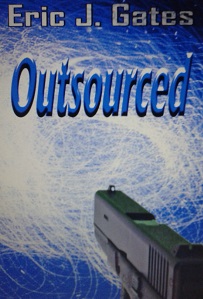
Outsourced – Eric J Gates

eric jFundamentally, this is a good story. Eric J Gates has written a strongly plotted book that quickly becomes an immersive page-turner.

Successful thriller writer Nic Stiles receives a mysterious package in the post, apparently from notorious mass-murderer Robert Polanski (I wouldn’t have picked that name either, but it’s not a big issue), and quickly becomes embroiled in an adventure involving shadowy government agencies, determined criminals, and a theoretical physicist. During the course of this, he is forced to team up with his literary rival, Phil Beasley, to get to the bottom of the mystery. One particularly successful element that helps to give Outsourced its unique character is the author’s use of magical elements in the story, something other crime and thriller writers tend to avoid. Gates proves that you can involve unusual and unexpected themes in a gritty and down-to-earth story, and the book is the better for it.

I did have some issues with the novel, however. At times, Outsourced speaks to the importance in indie publishing of hiring an experienced proofreader. Semicolons are overused and break the flow of some passages, and several words are unnecessarily capitalised. This is a shame, as the silly mistakes are distracting (at least, for someone sad like me), and detract from the pacy and gripping narrative.

Dialogue is often stilted, and acts too much as exposition throughout. Two entire chapters are centred around a conversation Stiles and Beasley have with physicist Claudia Chan, in which fairly well-known science trivia is explained as though it is ground-breaking research. On the off-chance that anyone reading hasn’t heard of Schrödinger’s Cat, there are other ways round it than having one of your main characters repeatedly exclaim ‘Tell him about the cat’ until your scientist character painstakingly explains the concept.

On this note, unnecessary detail sometimes stymies Gates’ voice, and he is often far too wordy. Sentences like ‘She spotted the person she was seeking, picking away at a keyboard with his left hand, as he simultaneously manipulated a wireless trackpad with his right in a display of cerebral bilocation which would be beyond her own, above average, coordination skills’ abound. In fact, the very first sentence of the novel nearly put me off from the beginning, and it is a testament to Gates’ tight plotting that I stuck with it.

Overall, I enjoyed this book, though I did feel it was badly let down by some unfortunate errors, and some dialogue and sentences that would have been better left out. This is one of the drawbacks to indie publishing, of course, and serves as a reminder of why good proofreading and copy-editing are vital!

Rating: 3.5 stars

profile2

Reviewed by Nick

Find this book on Amazon

The Unexpected Professor: An Oxford Life in Books – John Carey

unexpected profFirst, I must admit to a close friendship with the author. For many years now we have been bosom buddies drawn together by a shared love of books. We have had similar literary trajectories and our backgrounds, coming as we do from fairly humble (but not working class) backgrounds, nurtured by our respective grammar schools, are a neat fit.

We chose different career paths: he, an academic; your blogger, a publisher. In my case this was a simple choice; unlike John, I was a lazy child with a very average brain; he was demonically hard-working and possessed of a huge engine. Otherwise I have little doubt I would have taken over his Merton Chair in English at Oxford as soon as he vacated it.

I’d better clear up this friendship claim. Whenever I see John punditing on television, hear him on the radio or read him in The Sunday Times (where he has been lead book reviewer most of my adult life) I feel we know each other as siblings. I nearly always agree with him, and when I don’t, I feel I must have missed something. As well as being a brilliant chap he is engaging and never academic. He communicates at a level even I can grasp.

Well, you may have guessed that we have never met, never even passed on an escalator. So this book is a real treat for me. It outlines John Carey’s life, and in that it could claim to be a slight autobiography, but principally it is the story of his life through the books he has read, the poetry he has studied, all related to his career at Oxford. The early chapters give a fascinating account of family life, wartime evacuation and schooling. He, as I do, mourns the loss of grammar schools which provided Oxbridge with a far higher percentage of state school pupils than they now have. The destruction of a meritocratic system which actually worked is a tragedy. All we had to do was improve standards for those who went to the old secondary schools. Now Oxbridge is stuffed with public school products, some bright, some not, and foreign students who can pay exquisitely high fees. Bah!

Carey’s life in books. Everything from The Dandy and Biggles to Milton and Shakespeare get a mention and an analysis, sometimes fleeting, sometimes in some depth. It is a non-stop excursion in literature. Why does he rate Dickens? Who can’t he stomach, and why? Above all, he makes me want to read authors who have eluded me and reread those I have forgotten.

Whether or not you are a friend of Carey, join me, one of his closest pals, and discover his charm, his warmth and let his passion for literature envelop you for a few hours very well spent.

Rating: 5 stars

profile3Reviewed by Richard

Find this book on Amazon

Orange is the New Black: My Time in a Women’s Prison – Piper Kerman

6314763

I really enjoyed the Netflix series Orange is the New Black, and I was delighted to find out that there was a real-life memoir on which it was based. So, I hurried out and got it on my Kindle.

I did enjoy this book; it was an easy read, and an interesting one, and really added something to my experience of watching the show. I would certainly recommend it to any fans of the show as a foil to the experience of watching.

I did have some reservations. While acknowledging the existence of institutionalised racial and class prejudice, the tone tended towards the “I see now what I have done, and I have learned my lesson, and now I go back into society pitying those poor black/Hispanic women locked into a cycle of crime, and now everyone else can see how I have become a prison-mending superhero”, and I feel very conflicted because I am sure she has struck a huge blow for women in prison, and I am sure she does make a big difference on the board of prisons now she is a free woman, but in the end I found it a little self-congratulatory.

It’s a little navel-gazey, a little self-regarding. That niggled at me a little, but overall I would strongly recommend this book. And the TV series, at that!

Rating: 3.5 stars

Louise CAV ReviewsReviewed by Louise

Find this book on Amazon

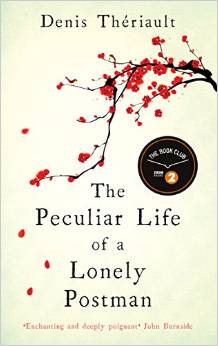
The Peculiar Life of a Lonely Postman – Denis Thériault

postman

I was so close to totally loving this book! It’s a very charming story, told with a wonderful lightness of touch, but there were just a few things that let it down. It tells the tale of Bilodo, a lonely postman who has been secretly reading the love-letters of a woman named Segolène.

At first, I found the writing a little “cutesy” for my taste, but I got into it, and there was real humour and paciness behind the tale. I was put off, also, early on by some really basic errors that should have been caught by the publishers – for example, Bilodo ‘volted’, rather than ‘vaulted’, up the stairs (COME ON, people) – and some basic formatting errors, including random words appearing in the middle of other words.

But it got going, and once I was about twenty pages in I couldn’t put it down until the end. It was funny and charming and written with this wonderful verve. And then the end. Oh the end! I loved the end. Loved it. What I didn’t love was the final chapter, which explained the end. It was already clear what had happened! You know how explaining a joke makes the joke less funny? Yeah, well, the same thing works for the ending of your novella. It was an immensely clever ending that tied all the themes and events of the novella together, and was then followed by this heavy-handed précis of why that all made sense. It spoiled for me the delicacy of the storytelling up to that point.

This was an almost-there book for me, but I would certainly heartily recommend it to anyone to try. It’s short, it’s entertaining, and certainly worth a read.

Since this book is full of haiku, I am also going to (attempt to) present my review in haiku form:

A charming little novella,
Reads very beautifully,
Until you explain the ending.

Rating: 4 stars

Louise CAV ReviewsReviewed by Louise

Find this book on Amazon