A Court of Thorns and Roses – Sarah J Maas

Rating: 5 stars

court of thorns and rosesI didn’t want to like this book, mainly because I have a great problem with people who spell fairy “faerie” because they think it is all “mystical”, but I enjoyed this so much that I even got over that.

This is just a great fantasy romance novel. It’s very exciting and absorbing – I read it in one go on the train (it was a three hour train) and I couldn’t put it down once I had got into it. It’s obviously written by someone who knows a lot of fairy mythology and who has cleverly incorporated this into a “beauty and the beast” style narrative. But that’s then taken one step further.

By far my favourite section was the last third, which I won’t spoil, in which Maas moves away from the source material and into something more original. It really comes to life there, and I will very much look forward to the next instalment. This third section does contain the easiest riddle EVER – I’m not sure how many smug points an adult woman can garner from finding a riddle for tweens easy peasy, but anyway…

There’s a deal of pearl-clutching on Amazon and Goodreads because this book has been put in the 11+ age bracket and it contains some s.e.x. (chorus of gasps). Obviously, it is the prerogative of every parent to make the decision based on each individual child, tween, etc. whether they are comfortable with them reading this stuff, but when you can flick past violent rapes on game of thrones at 9pm or read abusive stalking dressed up as romance over someone’s shoulder on the tube, I’m not sure that an eleven year old reading some explicitly consensual sex based in a deep emotional connection and mutual trust would be too disturbed. In fact, as a rare and welcome depiction of a woman with her own sexual desires and preferences I would probably encourage girls of the 12–15 age bracket to read this. After all, sex ed is on the secondary school syllabus from Year 7 so they will know what it is.

Aside from this, there are lots of women characters in the book that are just characters, and this struck me as (upsettingly) unusual. As in, they would not have needed to be women for the plot to work – usually there’s the main woman, the love rival, perhaps someone’s mother, but this book was populated by complex women and men loving complex lives, and I was shocked at how refreshing I found this. More of this kind of thing, please!

Louise CAV ReviewsReviewed by Louise

Find this book on Amazon

The Guinevere Trilogy – Lavinia Collins

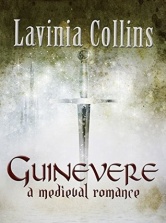
GuinevereFirst, an admission. Lavinia Collins is a good friend of this blog. You may have read some of her guest posts here and on the Chapterhouse website, and the more eagle-eyed amongst you will have spotted her hiding in our header picture. That said, we felt that her books deserved our attention. Lavinia is the author of three fantasy/romance trilogies, each set in the world of King Arthur, each taking on a different perspective. This first trilogy is written from the point of view of Queen Guinevere, and tells the story of her marriage to Arthur and [SPOILER ALERT] her subsequent affair with Arthur’s greatest knight Sir Lancelot.

What separates Collins’ work from other interpretations of the King Arthur legend is her focus on female experience. As she argues here, in most modern versions the female characters are less well-developed, serving mostly to move the story along, and have little agency of their own. The characters of Morgan and Morgawse, Arthur’s half-sisters, are often elided together, while Guinevere herself often seems to have little personality to speak of. Collins’ books turn this narrative on its head, giving each of these characters their own take on the story. The Guinevere Trilogy itself contains lashings of drama and romance, and references pre-Christian religion and the occult. There is a sense of a country in turmoil, uncertain of how to join up its wild and varying factions, stuck between one world and another. This sense is reflected in the mercurial Guinevere, torn between her different lives, kind at one moment and cruel the next. Having been pulled from her native land to marry her father’s conqueror at the opening of the story, and having had to adapt to a new religion and new customs overnight, we see Guinevere as conflicted in all things from the outset.

Set in a world where women have little power or autonomy, it’s wonderful to read an Arthurian story with a woman at the centre. The major pull of the book is the idea of a woman’s struggle to define herself and live her own life in a world defined by male interests. If that sounds up your street, you should definitely check it out.

profile2Reviewed by Nick

Find this book on Amazon

Asking For It – Louise O’Neill

Rating: 5 stars

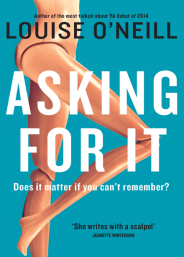
asking for itBecause we love indie books here, we don’t usually review or talk about mainstream prize-winning fiction here, but Asking For It does, I think, require speaking about.

I would just at this point say that this book deals graphically with rape, and might be upsetting to some readers. Certainly, I did not enjoy this book. It was a great book, and I was glad I read it, but I did not enjoy it. This isn’t a curl-up-by-the-fire book, this is an I-can’t-stop-reading-but-this-is-horrific book.

Loosely modelled on the Steubenville rape case, but set in Ireland, Asking For It tells the story of shallow, insecure, bitchy, selfish, vain Emma. Emma loves male attention. Emma constantly needs to belittle her friends to feel better about herself. Emma is gorgeous and she knows it. I’m pretty sure we are not meant to like Emma. I didn’t like Emma, but that didn’t matter.

So, what happens to Emma forces us to confront the question: what do we do when we don’t like the victim? How do we feel when a drunk, drugged up girl who’s shallow and unkind suffers something awful?

O’Neill’s book is a horrifying, unflinching portrayal of rape culture, sexual assault, and their after-effects in a tight-knit community. It’s searing and merciless and harsh. I couldn’t stop reading. It’s not for the faint-hearted but it does incredible work challenging our idea of what a victim is or should be. At no point did I feel that Emma deserved any of what she got, or that her suffering wasn’t valid because she wasn’t a ‘nice’ person – this journey inside that world really underlines that. It’s incredible stuff – just go in prepared.

Louise CAV ReviewsReviewed by Louise

Find this book on Amazon

The Constant Princess – Philippa Gregory

Rating: 2 stars

constant princess.jpgWe don’t usually publish reviews of less than three stars, but I think Philippa Gregory is big enough to take this one.

I was very excited to read The Constant Princess – Katherine of Aragon is a fascinating figure, very often shoved into the long-suffering-wife-of-philandering-husband pigeonhole – and I was excited to read about her.

The long and short of it is, this does not reflect Gregory’s best work. Where The Other Boleyn Girl and The White Queen combined historical research with fluid storytelling, bold characters and lots of sexy fun, The Constant Princess is very heavy on exposition, and the only character that really emerges from the page is Katherine herself.

There are moments that sparkle: Katherine’s negotiations with her father-in-law twice over, Henry VII, and the opening, set in Al Andalus in Muslim Spain, where we see brief flashes of the fascinating Queen Isabella. But these wonderful moments are swamped under so much plot exhibition, so much information and historical knowledge dump, that it really flattens the story out.

I loved the details about late-medieval Spain. I loved the setting at the beginning, but as the book wore on, it got weighed down. Henry VIII, when he appeared, had none of the charisma Gregory wrote so well in The Other Boleyn Girl. This seemed to be largely because of the vision Gregory made regarding the famous case of whether or not Katherine and Henry’s marriage was legal. I found that her decision about it (which I won’t spoil) was not implausible, but the way it led was a bit of a stretch.

So, would I recommend this book? I think I would as a repository of fascinating information on Muslim Spain. As a historical novel, not so much. It’s a shame, because so much of Gregory’s writing is so great. I’m going to keep reading.

Louise CAV ReviewsReviewed by Louise

Find this book on Amazon

The Story of Jax and Dylan – Jamie Dean

Rating: 5 stars

The Story of Jax and Dylan is a m/m romance that tells the story of two estranged friends. Dylan was in love with his friend Jax while they were at school, but after one awkward kiss just before the end of high school, they didn’t speak again until a chance re-connection via Facebook.

So, I did ummm and ahhh about giving this book five stars, because it wasn’t perfect. I thought there were places where it could have been pacier, and the in-depth description of how Facebook works that it opened with already seems dated, but in the end none of those things mattered.

jamie deanLike any truly great romance novel, The Story of Jax and Dylan wasn’t just about two people finding one another and falling in love. It was a nuanced portrayal of the struggle of living with a non-heterosexual identity in a modern society which is, in so many ways, beginning to be so accepting. About the potential emotional cost of silence and secrecy that surrounds teenage explorations of sexuality.

One of my favourite parts of the novel was how it was structured around another book, written by Jax, which was slowly revealed to be autobiographical. It made me wonder how far this story-in-a-story extended, and whether it was as far as the book I myself was reading. And I was glad I was left wondering.

I raced through this book in one go on a three-hour train journey (I think I scandalised the woman sitting next to me, but that’s her problem), and I’ve had a lot of time to think about it, and to think about what kind of review I wanted to write. Ultimately, the book really made me feel something. I thought it was very honest without having any kind of “this is the take home message” blah in it. It was sensitive and heartwarming without being schmalzy, and as well as telling a wonderful romance story, it really had something to say about the society we live in and the way we relate to one another. I would strongly recommend.

*Contains graphic sex

Louise CAV ReviewsReviewed by Louise

Find this book on Amazon

Mistress of Rome – Kate Quinn


*Contains spoilers. Venture forward at your peril!*

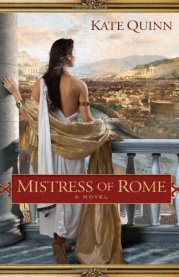
kate quinnMistress of Rome is a historical novel set in the reign of the Emperor Domitian. It follows Thea, a Jewish slave escaped from the mass suicide at Masada, Lepida, her mistress, and Julia, the niece of the Emperor.
In the main, I enjoyed Mistress of Rome; it was easy reading and nicely pacey. Descriptions didn’t drag and it moved smartly through the action. There was also a lot of lovely historical detail. Quinn had obviously done her research on ancient Rome, and both Domitian’s administration and his (reported) darker proclivities. All of that was wonderful.

There were also some (unintentionally hilarious) glitches with the e-book version I read. In several places, the word ‘toga’ had somehow been replaced with the word ‘synthesis’, and any time it was supposed to be (I think) ‘white toga’, it said ‘lawn synthesis’. Very bizarre.

Why less than four stars, then? The narrative moved around from perspective to perspective freely, which was not necessarily such a bad thing, only it did so so quickly and through so many different characters that it wore slightly. But my main issue was with the characterisation of one of the main characters. As with Patricia Bracewell’s historical novels, also reviewed here, the book had a bit of a Madonna/whore complex. Mistress of Rome was slightly better for that in that Thea, the ‘good’ character, had a little more light and shade in her than Bracewell’s irritatingly irreproachable Emma, but Lepida, Thea’s antagonist, was a complete stereotype, a parody of the shallow, manipulative, sex-crazed woman that seems to haunt even female writers, still. Most irritatingly of all, a certain male character whom we are supposed to see as good and honourable is portrayed as completely weak to Lepida’s seductions and is promptly absolved of any responsibility.

[*SPOILER AHEAD*] 

When Lepida is eventually strangled to death by someone who her Machiavellian plotting has deeply wounded, this is presented as something that we ought to be pleased about, and think she got what she deserved. While Thea had a history, a complex emotional past, and a personality, Lepida never developed beyond a cardboard cut-out. Perhaps I ought to be more lenient, since I did enjoy the book in the main, but it is just so endlessly tiring to read books over and over again that present women along the Madonna/whore dichotomy. Where women who are anything less than kind are always flashing-eyed evil seductresses. It’s time for something new, and really it’s female authors who ought to be leading the way.

Rating: 3.5 stars

Louise CAV ReviewsReviewed by Louise

Find this book on Amazon

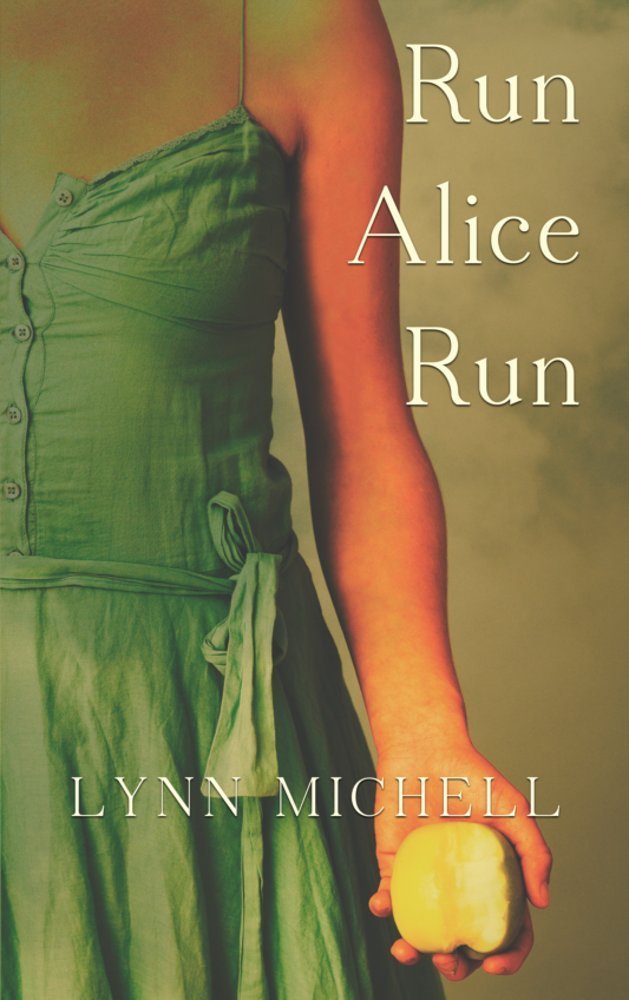
Run Alice Run – Lynn Michell

“Look, Sunshine, next week you ’ave a go at makin’ a very minimal contribution so that the rest of us don’t ’ave to tolerate you sitting there like left luggage. Okay?”
“I’m not very confident about expressing myself.”
“Of course you can bloody express yourself. You know how to open your mouth to flirt, don’t you?”

run alice runI’m very torn about this book. On the one hand, it’s a very rare thing – a literary novel (whatever that means) about female ageing and sexuality that pulls no punches, and it should be applauded for that. On the other, it could have used a really good edit. Certain sections are very long-winded, and – as demonstrated above – much of the dialogue doesn’t ring true.

Lynn Michell traces the story of Alice, her heroine, through her various relationships. Knocked back at every turn, her spirit is gradually crushed, and she begins to find some manic relief in shoplifting clothes. The novel opens with her being caught, and having to face a grilling from an unsympathetic and bullying police force. This is the first instance of what Michell is so good at: breaking down male/female relationships, and showing us where the power lies. Unfortunately, it’s also the first instance of Alice being an insufferable drip. Michell tries to mediate against this by introducing ‘interval’ sections throughout the book, in which Alice talks with her younger self, who we are told is confident, bold and fearless. Sadly, though, this doesn’t come across, and these parts are thus largely redundant. Because we never see Alice as a strong personality, it’s very hard to like her. She is the constant victim, beset on all sides by a swarm of pretentious, overbearing men.

First, there’s Julian, her teenage boyfriend who refuses to sleep with her for fear of compromising his A-levels (which seems unlikely, as does the suggestion that the other boys at school call her ‘Arte… Goddess of unexpected happenings’). Then there’s her affair with Oliver, the university professor who’s constantly cheating on his wife. There’s her brief marriage to political dissident Cal. And finally her second marriage to the creepy and withdrawn Stephen. On the surface, there’s a great story there, of a strong woman gradually being worn down. The problem is that there’s not enough differentiation between the male characters (they’re all bullies and snobs), and it’s hard to accept that Alice has ever been confident or assured, given that we never see it.

One thing that really works is Michell’s evocation of certain times and places. I spend a lot of time on the University of Birmingham campus, and it’s wonderful to trace back from the author’s description of it in the sixties and seventies, seeing what’s changed and what hasn’t. The other excellent bit of description is the crumbling Victorian tenements of Edinburgh, and Alice’s fear of being hemmed in by the lack of air and light, just as she is suffocated by her marriage to Stephen. The chapter headings are particularly good, all song titles from the past few decades (Let’s Spend the Night TogetherBreaking up is Hard to Do, etc.), and help to give a sense of the various periods covered. These elements, and the over-arching themes of the novel, are its saving graces.

Ultimately, though, Run Alice Run wasn’t for me. I couldn’t feel a real connection with the main character, and this undermined the many good things in the book.

Rating: 3 stars

profile2Reviewed by Nick

Find this book on Amazon

Kings and Queens – Terry Tyler

terry tylerI really enjoyed Terry Tyler’s Kings and Queens. It’s kind of Tudor history fanfiction in conception (it transposes the events of the reign of Henry VIII into the late twentieth century), and I don’t say that to disparage it, only that that’s the best way to describe how the idea behind the book works. The thing I would say about Tyler’s book that struck me the most is that it’s just immense fun. All of the characters are broadly drawn with a real sense of verve and humour, and moving through the decades of the seventies, eighties and nineties, we’re treated to a huge amount of kitsch detail that – for me – was one of the great enjoyment factors of this book. And if I had to describe it in one word that would be it – kitsch. And kitsch in the best possible way.

There are a few things that niggled during the reading, but not enough to detract from the overall enjoyment. There were some annoying grammar errors, the one that stuck in my mind was the room of ‘sleeping cheesecloth and denim-clad bodies’; at first, I thought things had got very avant-garde and sleeping cheesecloth was about to make an appearance in a sort of off-the-wall way, and then I realised that there was just a hyphen AWOL. My inner pedant on the loose, I know. The
second thing was that (and this is probably more to do with me) I kept trying to match everything up to what I knew from history. And you really can. Just a temptation to the obsessional, I suppose! I also have to say that that cover does not do the book justice at all. I really enjoyed Tyler’s book and I would never ever ever have bought a Kindle book with a cover like that. (I know – shame on me for judging a book by its cover.)

But those things aside, if you’re out for some kooky fun and you like either your Tudor history or your family sagas, Tyler’s book is definitely worth a read. And Tyler does write very well, with a lightness of touch and an economy of style that makes her work immensely readable. I’d certainly recommend it to friends of mine who wanted to read something quirky and fun.

Rating: 4 stars

Louise CAV ReviewsReviewed by Louise

Find this book on Amazon

The Good Neighbour – Beth Miller

good neighbourA huge vote of thanks to Beth Miller’s publishers, Ebury Press, for the timely arrival of this review copy. I’m struggling with slipped discs and spent 48 hours unable to do much except drink tea and read. And what better, more gripping read could I have had than Beth Miller’s second novel, The Good Neighbour.

It’s a compelling, well-written novel about a couple – Minette and Abe – who have a 9 month old baby – Tilly – and have been living with neighbours who constantly complain about the smallest noise emanating from them, making their lives unbearable. So their relief when new neighbours move in and are friendly is enormous. Her new neighbours are Cath and her two children, Davey (8) and Lola (4). They are a complicated family – Davey is in a wheelchair, suffering from Duchenne muscular dystrophy, while little Lola has multiple allergies, Cath explains. Andy, her husband, is working away as a driver, and they miss him and talk frequently on Skype.

Minette gets rapidly drawn into Cath’s world, joining her in training for a fundraising triathlon, pleased to have a change from the routine of looking after the baby while her husband is at work. And Minette is also drawn into much closer relationships with other neighbours, including handsome Liam. The readers soon realise that all is not well with Cath’s family – she is extremely keen to extract information about everyone else but very good at withholding information about herself and her family. And a series of events leads Minette to get enmeshed in the web of deceit which Cath has drawn around them. I don’t really want to give away more detail about the plot because it’s such a great tale, full of twists and turns, which keeps us in suspense throughout. It’s a terrific read which had me gripped.

It was all too easy to believe in Minette’s boredom and annoyance at her endless walks to the toyshop or the park, trying to keep little Tilly quiet (and to retain her own sanity), wondering whether to go back to her job or to give it up to become a permanent stay-at-home mother. It’s a dilemma which so many people face, and for Minette the first months have been even more difficult because of her constant worry about her neighbours complaining.

Cath is a wonderful creation – we hear her thoughts and her worries, her feelings of anxiety, and soon we realise that something is not right, and that she is not exactly what her new neighbours think she is. She covers her tracks, even to herself, really well, but at times things happen, inevitably, which are beyond her control and her complicated chains of stories begin to snap.

Beth Miller has again come up with a book which left me wanting more. There are lots of unanswered questions left at the end – could there be a sequel? I really hope so, as I’d love to hear what happens next to so many of these entirely believable characters.

Rating: 5 stars

Daisy Chapter and VerseReviewed by Daisy

Find this book on Amazon


Augustus – John Williams

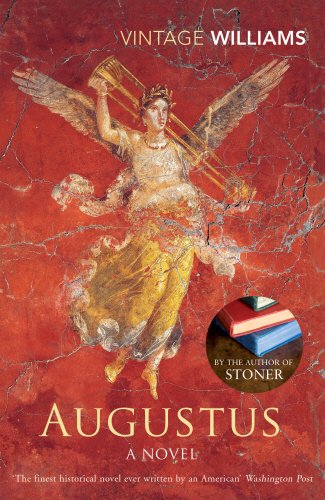
augustusBecause I like to think myself above everything zeitgeisty, when the John Williams revival hit fever pitch and everyone was raving about Stoner, I decided I needed to know what this was all about without leaping with both feet onto the bandwagon.

So, motivated by this and a lifelong obsession with Ancient Rome, I picked up Augustus.

I don’t like epistolary novels in general – I feel that the premise stretches my disbelief too far. I don’t often like novel adaptations of Roman history, because they are never as good as the immortal I, Clavdivs. It is rare that I am ever deeply impressed by the style of anything written after 1650.

I was stunned by Augustus. Williams’ prose is simple, and yet also lacks nothing. He has that rare gift of economy of description. I have seen Cleopatra represented time and time again. Williams’ Cleopatra appears for a total of about fifty words, most of which do not describe her, and yet I was left with a vivid image of a full character. The only other Cleopatra whom I have found so evocative is Shakespeare’s.

Why did I knock off half a star, I hear you cry. Well, as stunning and subtle as the novel was up until the last chapter, what I had thought was a sly and well-judged decision to only describe Augustus from others’ perspectives came crashing down around me, as Augustus speaks in a “letter” that takes up the last twenty or so pages, explaining away many of the pleasant ambiguities and giving the whole novel a rather different feel. I feel I would have swooned with joy at how transcendent it had all been if it had finished just one chapter earlier. As it was, I still very much enjoyed it, but I was left a little miffed.

That aside, I am sorry to say that I am now part of the John Williams zeitgeist bandwagon, and I am probably going to head out right now to the library to read Stoner

Rating: 4.5 stars

Louise CAV ReviewsReviewed by Louise

Find this book on Amazon